




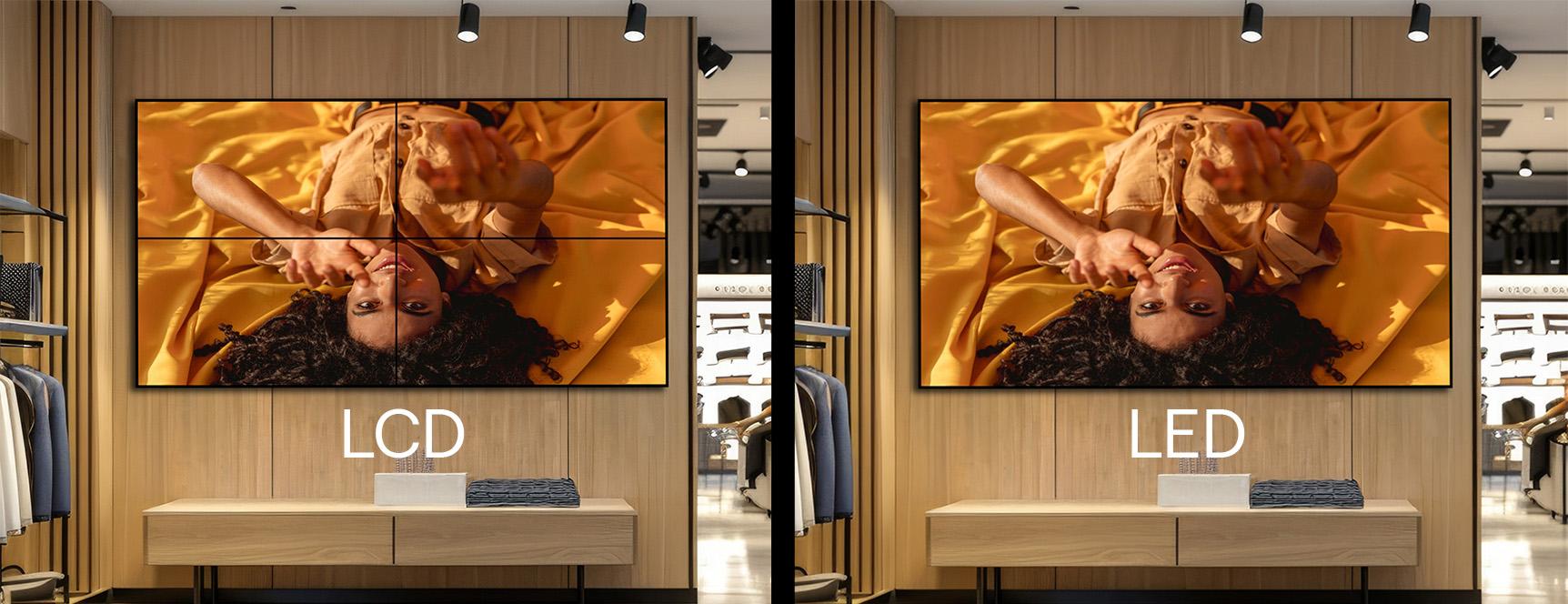
A technical comparison of Nanolumens NanoPanel 55 direct-view LED technology against two globally available leading display brands razor-narrow-bezel LCD video wall displays
Executive Summary
For many years, 55-inch (140cm) narrow-bezel tiled LCD display panels defined the standard approach for video walls in command centers, retail environments, airports, transportation hubs, higher education common areas and corporate spaces. Over the years large and diverse global manufacturers advanced the category with sub-millimeter bezel-to-bezel frames, 700-nit brightness, calibration tools and integrated Internet of Things (IoT) media players. However, even the best LCD video walls remain constrained by the physics of liquid crystal panels: visible bezel seams, reflective front glass, backlight degradation, panel-to-panel color drift, and whole-panel replacement when failures occur.
Direct view LED (dvLED) video wall technology removes most of the visualization challenges faced by LCD video wall users. Unfortunately, for organizations already standardized on traditional 55-inch displays, that may not be ready to replace their existing mounting or power infrastructure, modular or cabinet-based LED video wall deployment can be prohibitive.
Nanolumens’ NanoPanel 55 Full HD LED displays bridge the gap between the 55-inch LCD video wall and cabinet-based dvLED video wall worlds, reframing the comparison by delivering all the benefits of dvLED while maintaining the familiar 55-inch (140cm) display form factor. It is designed as a drop-in replacement for traditional 55-inch LCD flat panel displays and tiled LCD video walls that use traditional power, have HDMI connectivity and VESA mounting. NanoPanel 55 uses a 0.6 mm Chip-On-Board (COB) LED architecture to deliver Full HD 1920 × 1080 resolution with 800-nit brightness. Major benefits include 100,000 hours of 24/7 operation to LED brightness half-life, complete in-field system repair and removable trim allowing for nearly seamless digital canvas creation. The result is a practical migration path from LCD video walls to LED visual surfaces without forcing customers to redesign the entire ecosystem footprint.
This whitepaper concludes that for organizations with legacy 55-inch tiled LCD video walls, the NanoPanel 55 dvLED is the stronger long-term platform where visual continuity, uptime, serviceability, image uniformity, and total cost of ownership matter more than lowest initial hardware cost. Razor-narrow-bezel LCD remains viable for budget-sensitive deployments and applications where bezel seams are acceptable, but NanoPanel 55 provides a more future-ready architecture for mission-critical and critical customer-facing environments.
1. Display Technology Overview
1.1 Razor-Narrow-Bezel LCD Video Walls
LCD video walls create large visual canvases by tiling multiple 55-inch flat-panel displays. Each LCD panel uses a liquid crystal layer, backlight system, polarizers, electronics, and a protective front surface. Because each panel is a complete display, every tile has a physical bezel, which is typically black colored. Modern products have reduced this bezel frame dramatically: both Leading Brand #1 and Leading Brand #2 specify a 0.44 mm even bezel and 0.88 mm bezel-to-bezel design.
These advances make LCD walls much cleaner than earlier generations, but they do not fully eliminate disruptive tiled bezel seams. The grid-like bezels remain visible, and are especially apparent when displaying maps, wayfinding, flight information, fine text, dashboards, human faces, or brand imagery and advertising that crosses tile boundaries. LCD video walls also require ongoing calibration to manage color and brightness differences among individual displays as backlights age at different rates.
1.2 Direct-View LED Video Walls
LED displays generate images directly from light-emitting diodes. Unlike LCD, there is no separate backlight layer and no liquid crystal shutter. Each LED pixel is the light source, enabling higher contrast, deeper black levels, broader brightness control, and modular serviceability. Fine-pitch LED products also reduce the historical tradeoff between LED brightness and close-viewing resolution.
The Nanolumens NanoPanel 55 dvLED display is significant because it packages these advantages into a 55-inch (140cm) format with Full HD resolution and standard mounting compatibility. This makes it a direct modernization path for organizations that already have 55-inch (140cm) LCD infrastructure but want to remove bezel gridlines, reduce reflective surfaces, extend operating life and simplify service.
2. Product Comparison
| ATTRIBUTE | NANOPANEL 55 | BRAND 1 | BRAND 2 |
| Display Technology | Chip-On-Board dvLED | LCD, Commercial IPS-class | LCD, Commercial IPS-class |
| Screen Format | 55″ (140cm) Full HD 1920 × 1080 | 55″ (140cm) Full HD 1920 × 1080 | 55″ (140cm) Full HD 1920 × 1080 |
| Brightness | 800 nits | 700 nits | 700 nits |
| Power/BTU (average) | 150 watts / 512 BTU | 250 watts / 717 BTU | 270 watts / 717 BTU |
| Contrast | 5000:1 | 1000:1 | 1200:1 |
| Color | 13-bit | 10-bit | 8-bit |
| Seam/Bezel Impact | Removable trim supports bezel-free tiling | 0.44mm even bezel 0.88mm bezel-to-bezel gap | 0.44mm even bezel 0.88mm bezel-to-bezel gap |
| Service Model | Individual components field replaceable | Full display replacement & re-calibration required | Full display replacement & re-calibration required |
| IoT Media | Yes – External and onboard | Yes – External and onboard | Yes – External and onboard |
| Operating Life | 100,000 hours to half-life (11.4 years minimum) | 50,000 hours to life (5.7 years max) | 50,000 hours to life (5.7 years max) |
| Mounting / Retrofit | VESA industry standard | VESA industry standard | VESA industry standard |
| Best-fit Use Cases | Airports, transit, command centers, menu boards, retail, high-visibility signage, premium brand walls | Retail, control rooms, corporate, public spaces where LCD seams are acceptable | Retail, office, public spaces, video walls requiring narrow-bezel LCD economics |
3. Key Technical Benefits of Direct-View LED
3.1 Visual Continuity
The most visible advantage of NanoPanel 55 over Brand #1 and Brand #2 LCD video walls is the reduction of gridline disruption. Even with 0.88 mm tiled bezels, LCD video walls create physical separation between displays. This can distort faces, split letters, interrupt flight information rows, and reduce the perceived quality of premium visual content. LED provides a bezel-free continuous surface, allowing content to cross panel boundaries without visual interruption. This allows for a better customer viewing experience and opportunities to use the entire canvas with more windowing options for undisrupted content.
3.2 Higher Contrast and Reduced Reflection
LCD displays depend on backlights and liquid crystal modulation, so black levels are limited by how effectively the panel blocks light. LED pixels can be driven individually, improving perceived contrast and allowing darker blacks when pixels are dimmed or off. NanoPanel 55 is also glass-free and therefore a reflection-free alternative, which is important in airports, transit stations, restaurants, lobbies and other spaces with sunlight, bright ambient light or uncontrolled reflections.
3.3 Longer Useful Life and Better Lifecycle Economics
NanoPanel 55 is specified for 100,000 hours of operation to half-life while maintaining color accuracy and white balance. For 24/7 environments, that equates to more than 11 years of continuous use before reaching half brightness. By contrast, LCD video walls that rely on backlight systems can degrade unevenly across displays, increasing the need for calibration and raising the risk that replacement panels no longer visually match the rest of the displays installed in the wall. Typical lifespans of LCD system are 50,000 hours (5 years) to their known life expectancy. The NanoPanel 55 display having only reached half-life will continue to provide for operational use and it would not be unexpected to reach 15 to 20 years of useful product experience.
3.4 Field Serviceability and Downtime Reduction
With LCD video walls, a significant failure often requires replacement of an entire panel. That approach can be costly, disruptive, and visually inconsistent if replacement inventory differs in age, color performance, or manufacturing batch. LED displays are comprised of smaller modules that can be replaced individually, rather than the entire display. NanoPanel 55’s in-field repair model can reduce downtime, simplify spare-parts strategy and improve sustainability by replacing modules rather than entire displays.
3.5 Retrofit Practicality
A common objection to LED migration is integration complexity. NanoPanel 55 directly addresses this by preserving the familiar 55-inch (140cm) footprint and standard 400 × 400 VESA mounting pattern. For airports, transportation facilities, restaurants, campuses, and control rooms with existing VESA-based infrastructure, this lowers the barrier to LED adoption by allowing phased replacement rather than wholesale redesign.
4. Application-Specific Implications
- Airports and transportation hubs: Flight information, gate changes, baggage claim messaging, wayfinding, and emergency communications require legibility, uptime, and minimal visual interruption. NanoPanel 55’s bezel-free tiling and 24/7 LED lifespan are strong advantages.
- Command and control rooms: Operators need uniform brightness, consistent color, and readable data across the full wall. Eliminating LCD seams improves situational awareness when maps, camera feeds, and dashboards span multiple panels.
- Quick-service restaurants and menu boards: Reduced reflection, vivid contrast, and long operating life improve customer-facing signage while lowering maintenance disruption.
- Corporate and retail brand environments: Brand imagery benefits from continuous presentation. LCD seams can compromise premium design intent, while dvLED supports a more immersive canvas.
5. Cost Comparison and Total Cost of Ownership
Initial purchase price is only one component of display economics. A realistic comparison should include power consumption, heat load, service model, replacement cycles, spare inventory, calibration labor, downtime risk, and the cost of maintaining a visually uniform wall over time. For a like-for-like 55-inch (140cm) panel comparison, NanoPanel 55 has a higher expected up-front capital hardware cost than razor-narrow-bezel LCD; however, its lower average power draw, longer specified operating life, modular field serviceability, and elimination of whole-panel replacement can greatly improve lifecycle economics in always-on environments.
| COST FACTOR | NANOPANEL 55 | LCD BRAND 1 | LCD BRAND 2 | COST IMPACT |
| Typical Hardware | Higher initial cost; $7,000 USD/unit. (€6,100 EU) (£5,235 UK) | Lower initial cost; $4,600 (USD)/unit. (€4,500 EU) (£2,330 UK) | Lower initial cost; $5,500 (USD)/unit. (€4,200 EU) (£3,300 UK) | LCD usually wins on first cost; Evaluate LED on lifecycle value not initial price alone |
| Power Draw (avg.) | 150 W | 250 W | 270 W | NanoPanel 55 can reduce annual energy usage & associated cooling |
| Illustrative Annual Energy Cost Per Display (24×7 & $0.13 kWh USA) (€0.29 EU) (£0.26 UK) | ~$170/year (€381 EU) (£342 UK) | ~$285/year (€635 EU) (£569 UK) | ~$307/year (€686 EU) (£615 UK) | Energy savings scale with wall size; a 3×3 LED wall may save roughly $1035–$1,233 per year (€1,081 EU) (£922 UK) |
| Useful Life / Replacement Timing | 100,000 hours to half-life, or ~11.4 years before noticeable Display degradation | 50,000 hours, or ~5.7 years. Display is at the end of its tested lifespan | 50,000 hours, or ~5.7 years. Display is at the end of its tested lifespan | Longer LED life can defer refresh cycles & greatly reduce long-term capital replacement exposure |
| Service & Spares | Field-serviceable modular architecture; repair or replace individual components | Full display replacement with re-calibration is common | Full display replacement with re-calibration is common | LED can reduce spare display inventory, shipping cost, downtime, & mismatch risk after replacement |
| Calibration & Visual Uniformity | Maintains color accuracy & white balance over operating life | Requires calibration workflows to manage panel-to-panel color & brightness drift | Requires calibration workflows to manage panel-to-panel color & brightness drift | LED’s reduced calibration burden improves operating cost & protects perceived quality |
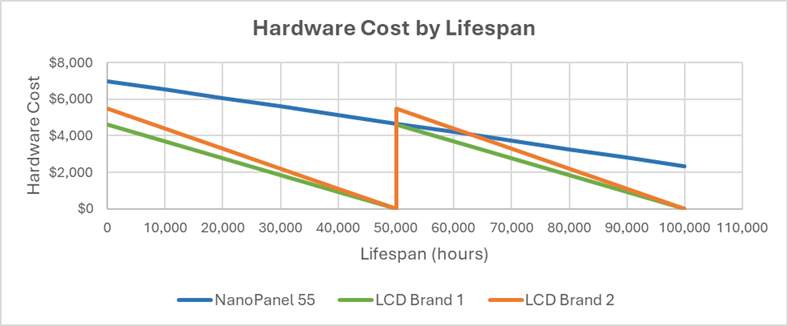
As shown in Figure 1. Given the expected lifespan of LCD video wall displays (50,000 hours) compared to the LED NanoPanel 55 (100,000 hour half-life), organizations would need to replace LCD displays at least once during the LED display’s lifespan; making the total hardware cost higher for LCD; totaling at least $9,200 for LCD Brand 1 and $11,000 for LCD Brand 2.
As an illustrative operating model, one NanoPanel 55 running continuously is averaging a savings of 40% in power consumption. This does NOT include local demand charges, HVAC savings from reduced heat output, installation labor, maintenance truck rolls, calibration labor, spare inventory carrying costs and downtime impact.
For a single display, the energy delta alone will not usually offset the full purchase-price premium of dvLED. The stronger business case appears in multi-panel, always-on, mission-critical, or customer-facing deployments where downtime, panel mismatch, replacement logistics, visual seams, and refresh-cycle timing carry meaningful business costs. In those environments, NanoPanel 55 should be evaluated as a lifecycle-cost reduction strategy rather than a simple hardware substitution.
Under total return on investment analysis, the NanoPanel 55 over its known half-life of 11+ years offers a substantial return on investment. While it might not recoup the initial capital outlay in year 1, after the first replacement of an LCD solution (typically in year 5) the NanoPanel 55 gains a 41% cost return advantage. There is also a 57% advantage return at year 10 with the ability to still perform past a 10-year technology refresh cycle.
For a video wall the return on investment can be extreme, the energy delta alone will not usually offset the full purchase-price premium of dvLED. The stronger business case appears in multi-panel, always-on, mission-critical, or customer-facing deployments where downtime, panel mismatch, replacement logistics, visual seams, and refresh-cycle timing carry meaningful business costs. In those environments, NanoPanel 55 should be evaluated as a lifecycle-cost reduction strategy rather than a simple hardware substitution.
6. When LCD Still Makes Sense
Brand #1 and Brand #2 LCD video wall displays remain credible choices where procurement teams prioritize lowest upfront capital cost, where existing LCD service processes are already standardized, or where content is segmented so that tile seams do not materially affect readability. They also offer mature commercial display features, wide viewing angles, calibration tools, multiple inputs and established video wall installation practices. For applications with limited operating hours, controlled lighting and less demanding aesthetic requirements, razor-narrow-bezel LCD can still deliver acceptable value, particularly in the short-term, as LCD video wall technology manufacturing continues to decline.
7. Sustainability and Environmental Impact
Sustainability should be evaluated across the full display lifecycle, not only at the point of purchase. For always-on video walls, the most important environmental variables are energy consumption, heat output, service model, replacement frequency, shipping and spare inventory requirements, and end-of-life electronic waste. In this context, NanoPanel 55 strengthens the case for LED by combining lower average power draw with longer useful operating life and repairable architecture.
The power comparison in this whitepaper shows NanoPanel 55 averaging 150 watts versus 250 watts for Brand #1 and 270 watts for Brand #2. In a 24/7 environment, that reduction directly lowers electricity use and can also reduce the cooling load created by display heat. For large tiled walls in retail spaces, command centers, transportation hubs and airports, these savings scale with every panel added to the wall.
Serviceability is equally important. Traditional LCD video walls often require whole-panel replacement when failures occur, which increases packaging, freight, spare display storage, and e-waste exposure. NanoPanel 55’s in-field repair model supports component-level service, allowing failed parts to be replaced without discarding an entire display. This approach can reduce material waste while also improving uptime and lowering service-related emissions from truck rolls and expedited shipping. The longer 100,000-hour half-life specification also supports more sustainable procurement. Extending the refresh cycle reduces the frequency of full display replacement and allows facilities teams to make better use of existing mounting infrastructure. When combined with VESA compatibility and a familiar size, NanoPanel 55 enables retrofit projects that reuse portions of the installed environment rather than forcing a complete redesign. The result is a display strategy that can reduce operational energy, lower material turnover, and align visual infrastructure decisions with broader sustainability goals.
8. Recommendation
Organizations evaluating a new video wall or a refresh of an existing LCD wall should treat dvLED as the strategic platform for high-value visual communication. NanoPanel 55 is especially compelling because it bridges the traditional gap between 55-inch (140cm) LCD convenience and LED performance. It provides the same familiar deployment geometry while improving visual continuity, serviceability, brightness, contrast, operating life, and long-term return on investment.
For mission-critical, always-on, or customer-facing environments, NanoPanel 55 should be positioned as the preferred replacement for Brand #1 and Brand #2 razor-narrow-bezel LCD walls. LCD remains an option for cost-sensitive projects, but dvLED better aligns with modern expectations for seamless imagery, reduced maintenance, and durable visual infrastructure. The NanoPanel 55 is a less-risk, less-worry solution for critical operating environments.
9. Conclusion
The evolution from razor-narrow-bezel LCD to dvLED is not merely a cosmetic upgrade. It changes the operating model of the video wall from a tiled set of independent LCD screens into a more seamless, modular, serviceable, and durable visual platform. Nanolumens NanoPanel 55 makes that transition practical by matching the 55-inch (140cm) LCD footprint while delivering the core advantages of fine-pitch LED. For environments where every pixel, message, and hour of uptime matters, dvLED offers the stronger technical and economic case.
Connect with a Nanolumens representative for more information.